


Purchase-order funding can solve a specific problem: your business has a real order, but it cannot pay the supplier or fulfilment costs before the buyer pays. It is not a cure for every cash-flow shortage, and a purchase order does not automatically make a transaction safe or profitable.
The honest test is not simply, “Can this order be funded?” It is, “Will funding this order leave the business stronger after every cost, delay and delivery risk is considered?”
For a South African SME, purchase-order funding is usually a poor fit when the order is not verified, the buyer or repayment source is uncertain, the supplier path is weak, the margin cannot absorb the full funding cost, or the business needs money for purposes unrelated to that order. In some cases, supplier credit, invoice finance, an overdraft, asset finance, phased delivery, a customer deposit or no external finance at all will be a better choice.
Who this is for
Purchase-order funding is transaction-linked working capital. A funder assesses a specific purchase order, the buyer, the supplier or fulfilment plan, the business’s capacity to deliver and the expected repayment source. Depending on the facility, money may be paid directly to suppliers and repaid when the buyer settles the resulting invoice.
That structure matters. It means the finance is generally intended to fund an identifiable order, not to repair historic losses, cover unrelated payroll indefinitely or finance speculative stock without a committed buyer.
Ndzinga Capital describes its own product as working-capital support linked to a verified purchase order. Its published assessment includes the order, buyer, supplier or fulfilment plan, business documents, affordability and credit information. It also says applicants should consider another path if they have only a quotation or verbal promise, the buyer cannot be verified, or the order margin does not cover funding costs. See Ndzinga’s purchase-order funding criteria and process.
Who this is not for
1. You do not yet have a confirmed, verifiable order
A tender submission, supplier quotation, award expectation, forecast, letter of intent or verbal commitment is not the same as a purchase order that can be authenticated with the issuing buyer.
Do not incur finance costs against an opportunity that can still change materially. Before applying, confirm at least:
- the correct legal names of buyer and supplier;
- the goods, quantities, specifications and delivery location;
- the price, VAT treatment and payment terms;
- acceptance, inspection and invoicing requirements;
- whether the buyer may cancel, vary or defer the order;
- whether the person issuing the order had authority to do so; and
- whether the funder can verify the order directly with the buyer.
If any of these points is unresolved, the first task is commercial verification, not finance.
2. The buyer’s ability or willingness to pay is uncertain
The purchase order is not cash. Repayment usually depends on the buyer accepting delivery and paying the invoice. A well-known buyer may still dispute an invoice, delay approval, reject non-compliant goods or require missing documents before payment.
Public-sector payment rules illustrate the difference between a prescribed term and actual cash timing. Section 38(1)(f) of the Public Finance Management Act requires a departmental accounting officer to settle contractual obligations within the prescribed or agreed period. Treasury Regulation 8.2.3 generally requires creditor payments within 30 days of receiving an invoice unless a contract or other agreement determines otherwise. Yet National Treasury continues to publish quarterly and annual reports specifically monitoring non-compliance with supplier-payment requirements.
The practical lesson is simple: model the legal or contractual due date, but stress-test a later cash date. Ask what happens if payment is delayed by an invoice dispute, missing delivery proof, Central Supplier Database issue, internal authorisation problem or budget constraint. Those are among the causes National Treasury has identified in its supplier-payment reporting.
If the business cannot survive a delay without missing wages, tax, rent or another critical obligation, the order may be too risky to fund in its current form.
3. The gross margin looks positive, but the cash margin does not
A large order value can hide a weak transaction. Calculate the cash left after every cost required to deliver and finance the order.
Start with the buyer’s price excluding VAT where appropriate, then deduct:
- supplier cost;
- freight, insurance, customs and clearing;
- packaging, storage and handling;
- labour, installation or subcontractor costs;
- quality testing, compliance certificates and permits;
- funding fees and legal or administration charges;
- bank charges and payment-control costs;
- foreign-exchange movement where imports are involved;
- expected wastage, returns or remedial work; and
- a realistic delay and contingency allowance.
Use this decision formula:
Net order contribution = customer proceeds minus all fulfilment costs minus all finance costs minus contingency.
Then ask whether that contribution justifies the operational and payment risk. If a modest delay, supplier price increase or rework event removes the profit, funding does not fix the order. It magnifies a fragile transaction.
Do not rely on a headline rate alone. Request a written rand-value illustration showing the total amount repayable under the expected timeline and under a delayed-payment scenario. Ndzinga states that written terms, fees and the repayment structure are disclosed before commitment. That is the level of clarity a business should require from any provider.
4. The supplier or fulfilment path is not dependable
Finance cannot make an unreliable supplier deliver correctly. If the supplier misses the specification or deadline, the buyer may reject delivery while funding costs continue and repayment obligations remain.
A credible fulfilment plan should answer:
- Is the supplier a real, registered and contactable business?
- Has the quotation been verified directly?
- Are stock, lead times and delivery dates confirmed in writing?
- Who carries loss or damage in transit?
- What inspection occurs before final supplier payment?
- Are warranties, returns and replacements documented?
- Can an alternative supplier perform without destroying the margin?
- Does the SME have the people, licences and systems to complete its part?
If a transaction requires several untested subcontractors, imported goods with uncertain lead times or technical work outside the SME’s experience, restructure it before funding. Options include milestones, staged supplier payments, independent inspection, a delivery partner or a narrower first order.
5. The funding need is not actually tied to fulfilment
Purchase-order funding is too narrow when the real need is general working capital. If the money is primarily for historic creditors, rent arrears, taxes, marketing, equipment or a long operating runway, forcing that need into a PO facility creates a mismatch between the use of funds and the repayment event.
A live example of product-specific exclusions comes from Standard Bank’s provincial government purchase-order facility. Its published page says funding is for eligible orders from selected government departments, is repayable when the department pays, and excludes uses such as paying other debt, property purchases, mergers and acquisitions and start-up capital for a business idea. The exact limits and exclusions are product-specific, but they show why SMEs must compare the actual purpose of the facility with the actual cash need. Review the Standard Bank provincial purchase-order funding terms.
If your need is broad and recurring, investigate a properly matched working-capital facility rather than repeatedly financing isolated orders.
Better alternatives
External finance is not automatically the best answer just because it is available. Compare it with:
- Supplier credit: If the supplier will accept payment after delivery or near the buyer’s payment date, the timing gap may shrink or disappear.
- Customer deposit or milestone billing: A deposit, mobilisation payment or phased acceptance can transfer less funding cost to the SME.
- Invoice finance: If delivery is complete and the issue is an unpaid invoice, post-delivery invoice finance may match the asset better.
- Overdraft or revolving working-capital facility: This may be better for recurring, flexible needs if the business qualifies and the total cost is lower.
- Asset finance: Use this when the core need is machinery or equipment with a useful life beyond one order.
- Phased delivery: Smaller batches can reduce peak cash exposure and prove performance before the full commitment.
- Own cash: This can be sensible only if it does not strip the business of its operating buffer.
South Africa’s public small-enterprise finance application criteria reinforce the broader principle that finance must remain viable and repayable. The Small Enterprise Finance Agency’s published criteria require economic viability, forecast cash flow showing repayment ability, relevant skills and experience, legal compliance and an assessment on the merits and potential profitability of the business. Its portal lists a general loan range of R50,000 to R5 million, but range is not the same as suitability. See the sefa eligibility criteria.
Limitations and trade-offs
Approval does not prove operational readiness. An order can be financeable but still be too large for the SME’s current controls, team, supplier network or customer concentration.
Warning signs include:
- one order consumes nearly all management attention;
- failure would threaten the whole business;
- the buyer becomes the dominant source of revenue;
- delivery depends on one person or one supplier;
- there is no buffer for defects, returns or penalties;
- the business cannot run existing contracts while fulfilling the new one; or
- directors must provide support they do not fully understand or cannot afford.
Growth should not convert a temporary working-capital gap into existential risk. Consider reducing the order, partnering with an experienced operator, negotiating milestones or walking away.
A practical pre-funding decision test
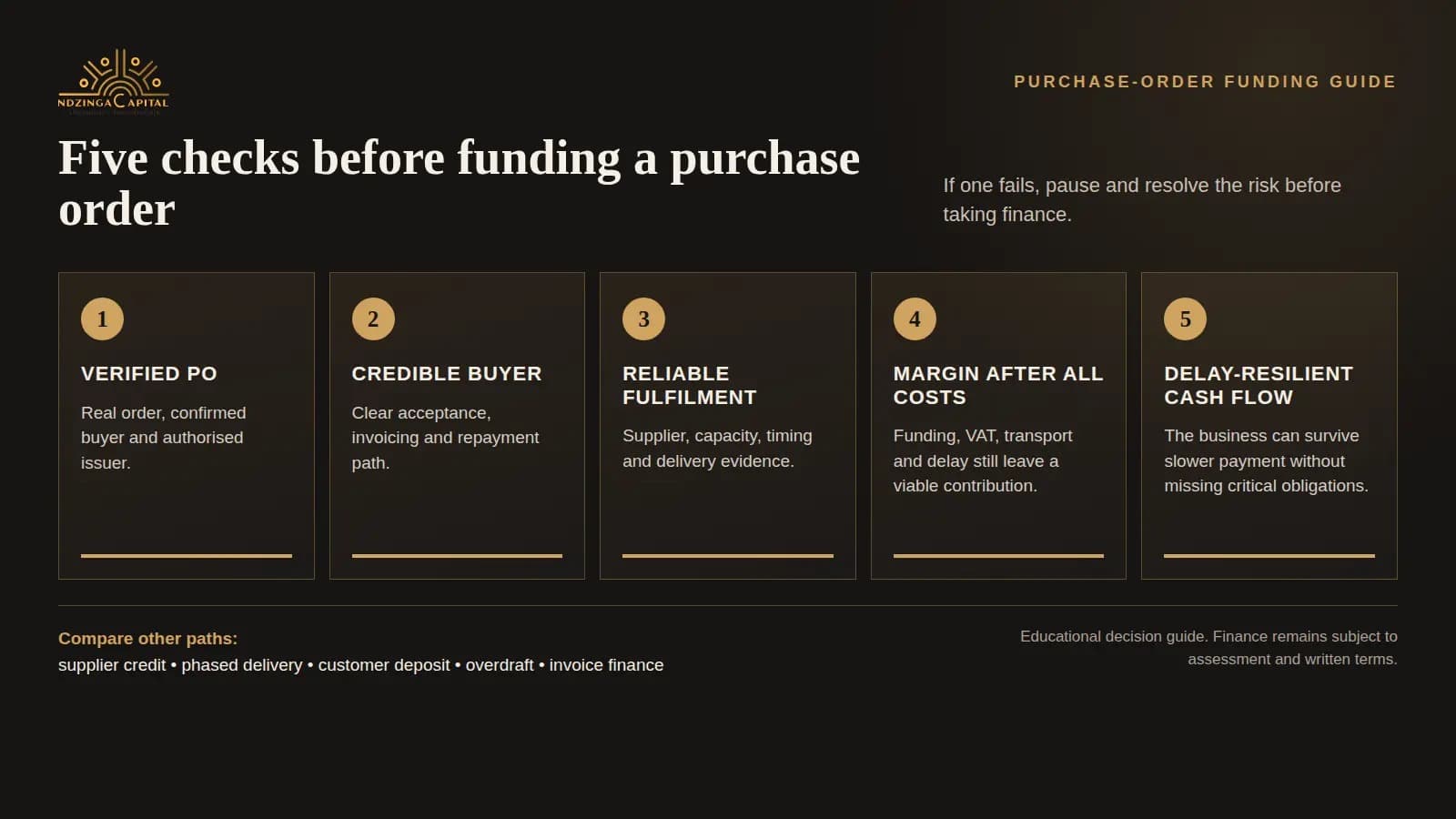
Before signing, require a one-page transaction file containing the following:
Order evidence
A verified purchase order, buyer contact, contract terms, acceptance criteria and authorised delivery dates.
Full cost sheet
Every direct and indirect fulfilment cost, the finance cost in rand, VAT timing and contingency.
Cash-flow timeline
Dates for supplier deposits, production, delivery, acceptance, invoicing, expected buyer payment and facility settlement. Add a delayed-payment case.
Risk ownership
A written answer for who bears cancellation, defects, transit loss, foreign exchange, late delivery, buyer dispute and supplier failure.
Exit comparison
The net cash outcome under PO funding versus supplier credit, a customer deposit, invoice finance, an overdraft, phased delivery and declining the order.
Choose the option that protects the business, not the option that merely makes the order possible.
Questions to ask a purchase-order funder
Ask for clear written answers before commitment:
- What is the total finance cost in rand under the expected cycle?
- What additional cost applies if the buyer pays late?
- Who receives funds and who controls the collection account?
- What happens if the buyer disputes, cancels or partly accepts the order?
- Are guarantees, cessions, security or director obligations required?
- Which fees are payable before funding or if the transaction does not proceed?
- Can suppliers be changed, and who approves the change?
- What documents trigger payment to the supplier?
- What is the complaints process and regulatory status of the provider?
- Can the business settle early, and does that reduce the cost?
Do not proceed until the answers match the written agreement.
Frequently asked questions
When is purchase-order funding usually a good fit?
It is generally a good fit when an SME has a verified order from a credible buyer, a reliable supplier or fulfilment plan, enough margin to absorb all costs, and a clear repayment path when the buyer pays.
Can a quotation or tender expectation be funded like a purchase order?
Usually not as a verified PO transaction. A quotation, forecast or verbal promise does not provide the same evidence of a committed order. Resolve the order status and buyer verification before seeking transaction-linked finance.
Is invoice finance the same as purchase-order funding?
No. Purchase-order funding normally addresses costs before delivery. Invoice finance normally releases cash after goods or services have been delivered and an invoice exists. The correct choice depends on where the cash-flow gap occurs.
What is the most important calculation before accepting funding?
Calculate the net order contribution after all fulfilment costs, the full finance cost, VAT timing and a realistic contingency. Repeat the calculation with delayed buyer payment. If the order no longer produces acceptable cash profit, do not fund it without restructuring.
The bottom line
Purchase-order funding is valuable when it finances a verified, deliverable and profitable transaction. It is the wrong choice when it is being used to manufacture certainty that the underlying order does not have.
Verify the buyer. Test the supplier. Price every cost. Stress the payment date. Compare alternatives. Then decide whether the order supports the business, rather than allowing the excitement of the order to dictate the finance.
Sources consulted
- Ndzinga Capital: Purchase-order funding
- National Treasury: Compliance on Payment of Suppliers
- Standard Bank: Provincial government purchase-order funding solution
- Small Enterprise Finance Agency: Eligibility criteria
Check whether your order is ready for assessment
Bring the verified order, buyer details, supplier plan and full cost sheet. Ndzinga will assess the transaction and disclose written terms before commitment.
Legal references
- Public Finance Management Act 1 of 1999, section 38(1)(f): Requires accounting officers to settle contractual obligations within the prescribed or agreed period.
- Treasury Regulations issued under the PFMA, section 8.2.3: Generally requires payment to creditors within 30 days of receiving an invoice unless another period is agreed.
Thinking about credit?
Start with the facts. Check your eligibility and estimate repayments before you apply — no obligation.
This article is general financial education, not personal financial or legal advice. Credit approval remains subject to affordability assessment, verification, and the applicable Ndzinga Capital credit policy.